History of tantrism
DEFINITION:
“Tantrism” is a term coined in the West in the 19th century, derived from the word tantra (Sanskrit IAST; devanāgarī : तन्त्र ; “rule, treatise”). It refers to a body of texts, doctrines, rituals and initiatory methods that spread widely through most branches of Hinduism (including Jainism). Its exact definition and historical origin are still debated among specialists. It is expressed through yogic practices and rites based on texts, or tantras, revealed according to legend by Shiva Himself, especially for fallen humanity in the last age (kali yuga) of Hindu cosmology. From the 6th century onwards, tantric cults are found in the Shaivite and Shakta schools, in Mahāyāna Buddhism (practised mainly in China, Korea, Japan and Vietnam) and in Vajrayāna Buddhism (Diamond Vehicle Buddhism, also called tantric Buddhism), practised mainly in Tibet, Mongolia and Japan.
Tantric literature consists of texts with various names such as tantra, saṃhitā, āgama and even some sūtras; the difficulty lies in counting those that fully belong to tantrism (experts count between 84 and 106).
ORIGIN:
Tantra is a term applied to a practical metaphysical system that originated in the Himalayan and Indian region. In this system, the universe is considered to rest on two principles, symbolised by the male and female couple. Traditional tantra is a “path of integral transformation of the human being”, which passes through the body and the five senses.
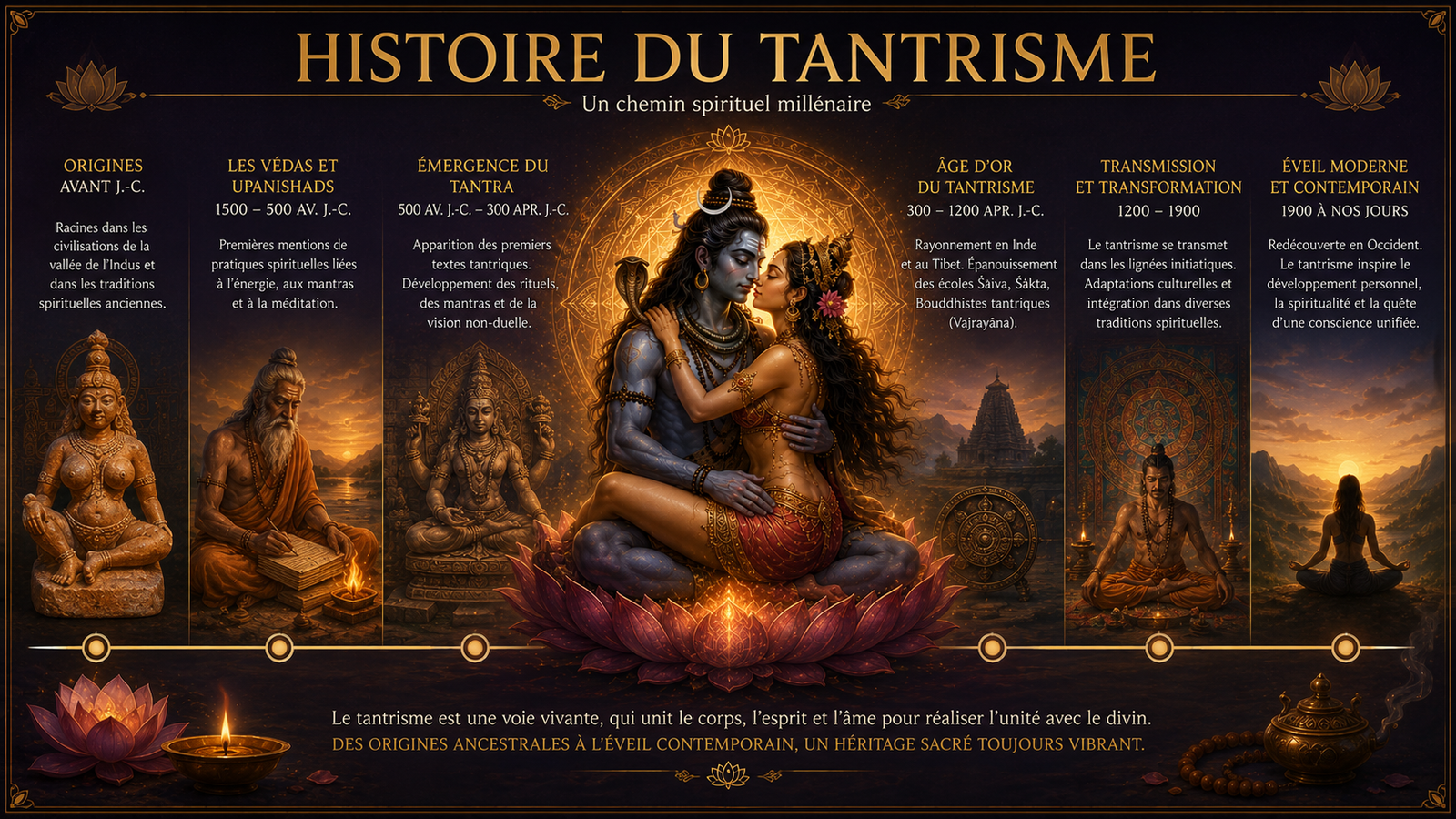
The tantras are texts that present themselves as the continuation of the Vedas. The Vedas are liturgical and ritual formulas that appeared in India between 1500 and 1000 BC and may go back to an even older tradition. They were not written down before the 8th century BC. Many commentaries arose from these liturgical and ritual texts.
After Vedism, which places desire (kāma) at the origin of Creation, Brahmanism developed, on the contrary, an “ideology of retention”. Tantrism emerged in reaction, to restore kāma as a path to liberation (moksha).
Emerging in the Indus valley, at a date on which specialists cannot agree, this metaphysics rests on two principles: an omniscient “presence” and an “act of becoming aware”. The two principles are symbolised respectively by Shiva and Shakti, who, although they bear names taken from Hinduism, are not identified with these gods.
OVER TIME, UP TO THE PRESENT DAY IN THE WEST:
Tantrism was a philosophy officially associated with Hinduism and Buddhism, which developed in India, Tibet, Nepal, Afghanistan, China and Japan.
Then, faced with persecution by religious extremists, it disappeared from the official cults as a tradition in its own right.
Nowadays, out of ignorance, the name “tantra” is given to sex-therapy practices that are often very far from the spirit of original tantrism. Tantrism has suffered from a New Age approach, which has too often seen it as “a ritualisation of sexuality, whereas it is the sexualisation of ritual” (see the introduction to David Gordon White, Kiss of the Yogini).
Today, there are two currents of tantrism:
- dakṣiṇācāra, right-hand tantra, orthodox, also called white tantra, the path of development through the mind, which practises mantras (short sacred invocations), yantras (geometric figures), visualisation, seated meditation, postural yoga and devotion through various forms of temple worship, following the path of renunciation.
- vāmācāra, left-hand tantra, also called red tantra, the path of experience through the body in order to reach a higher level of consciousness.
Our pages workshops, training courses, massages and treatments
Find us also on the following media, social networks, books and websites
Book
Well-being directories
- Résalib – practitioner in Aveyron
- Guide Tantrique – our massages
- Guide Tantrique – our workshops
- Le Guide du Bien-être – our estate
- Amedcine – massages and treatments
- Annuaire des Thérapeutes – massages and treatments
- BeautePresta directory – our services
- Éveil & Sens on Bio et Bien-être
Tourism & Discovery
- Aveyron Tourist Office – our establishment
- TripAdvisor – Éveil & Sens
- Google Maps – for our services
Listings
- Le Petit Futé – our massages and treatments
- Le Petit Futé – the Ô Cèdre Bleu estate
- Yelp – massages and treatments
- Yelp – our Ô Cèdre Bleu estate
- Pages Jaunes – Éveil & Sens
Do you read us often? Tell Google
Add Éveil & Sens to my sources